
Pressed in the room. Answered by a person.
Call stations, corridor lights, nurse station displays and wireless pendants for retirement homes, long-term care and hospitals. Designed, installed and serviced by the same team that does your phones and cabling, and tied into the phones so a call reaches a caregiver wherever they are.
East wing
West wing

From the pull cord to the phone in a caregiver's pocket.
A nurse call system is a chain: the station a resident presses, the light and tone that tell staff, and the path that gets a person to the room. We design, install and service every link, so there is one team to call.
- 01
Call stations in every room
Bedside buttons, washroom pull cords and emergency stations, placed where a resident can reach them from the bed, the chair and the floor.
Bedside · washroom · emergency - 02
Corridor lights and tones
A dome light above the door and a tone at the station, so staff see which room is calling from the hallway, before they look at a screen.
Dome lights · zone lights · tones - 03
Nurse station display
A board or console at the station that shows every active call, how long it has waited and where staff are, for the whole wing or the whole building.
Annunciator · console · wing or site - 04
Wireless pendants
A button a resident wears, so a call can be made from the lounge, the garden or the floor of a washroom, not only from the wall.
Wrist · neck · wireless stations - 05
Where the call came from
It is not enough to know that someone needs help. With RFID and wireless location, staff can see where in the building the pendant that was pressed is.
RFID · wireless location · by wing or room - 06
Wellness monitoring
Non-intrusive sensors in a resident's living space watch daily activity and flag what is out of routine, so staff can look in before it becomes an emergency.
Sensors · daily activity · alerts to staff
The call finds the caregiver, not the other way round.
A light in the corridor only helps the staff who are in the corridor. When the nurse call is tied into the phone system, a call from a room can also ring the caregivers' phones and open a voice path, so a resident can say what they need and the right person goes, from wherever they are.
- Rings the phones · the station, the wing's cordless phones, or a group
- Voice to the room · a caregiver can talk to the resident before walking
- Lights and board stay · the phones are an extra path, not a replacement
- One system to call about · we install the phones too, see business phones
The resident presses
Bedside button, pull cord or the pendant they wear.
The wing sees it
Corridor light, tone, and the room on the station display with a timer.
A phone rings
The caregivers' phones ring too, and whoever answers can speak to the room.
What the phone tie-in can do depends on the nurse call system and the phone system in the building. We confirm it on the site visit and test it from every station before handover.
Three kinds of building, three different systems.
The same parts, arranged for how care works in your building. Here is what we would typically put in.
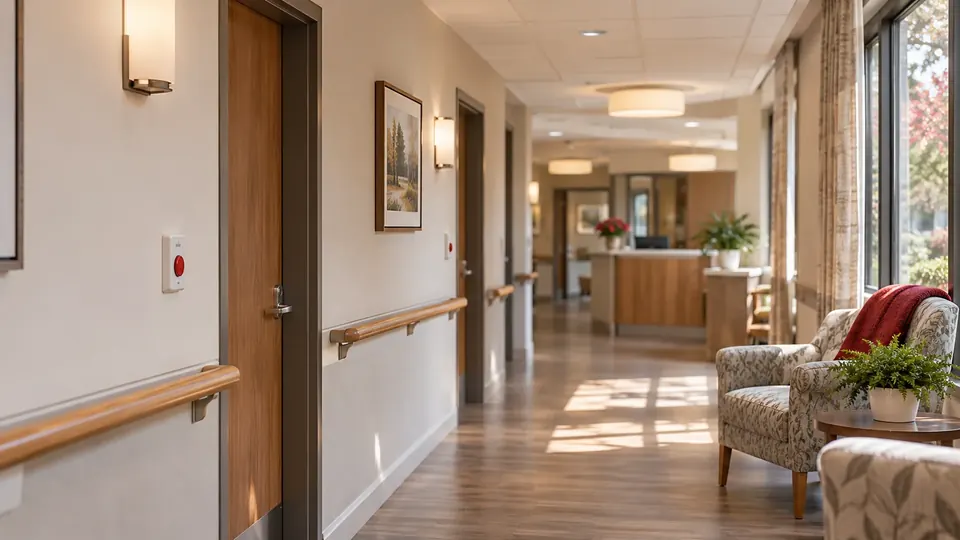
Retirement home
Suites · dining · lounges · gardens
- Suite stations plus wireless pendants, so the call works in the lounge and outside
- Calls to the staff phones, because there is rarely someone at a station
- Wellness monitoring for residents who live alone in their suite
Long-term care
Wings · shared rooms · washrooms · nurse stations
- Bedside stations per bed, pull cords in every washroom
- Corridor lights and a board at each station, with staff presence
- Wireless location so a pendant pressed in a common area is found fast
Every station pressed. Every light checked.
A nurse call system that has one dead station is a system nobody trusts. So we lay the stations out on your floor plan with your staff, cable them properly, and test every single one, with the lights, the tones and the phones, before we hand over.
- Stations placed with the care staff · from the floor plan, reachable from bed, chair and floor
- Every station tested · light, tone, display and the phone path, room by room
- Head-end in the rack · labelled, on the UPS, with the phones and the network
- Staff shown how it works · and a sheet of what was tested, left with you
New building or an old system, we can work with it.
Already have a nurse call?
Many buildings have a system that mostly works: a station or two that are dead, a head-end nobody supports any more, and no way to get calls to the phones. We service existing systems, replace what has failed, and can often keep the stations and cabling while bringing the head-end up to date. We will tell you on the site visit what stays and what goes.
Building or renovating?
Bring us in at the drawings. Nurse call cable goes in with the data drops and the phones while the walls are open, the head-end goes in the same rack as your network, and the whole low-voltage scope is one crew and one schedule. See cabling and fibre.
The rest of the building, from the same team.
Nurse call is one piece. We install the phones it rings, the doors it sits behind, the cameras in the corridors and the cable it runs on, so there is one number to call.
Stations where hands can reach. Lights where eyes look.
Stations at the bedside and in the washroom, dome lights over the doors, and the head-end in the rack with everything else.
Tell us about the building. We'll walk every room.
We'll count the stations, look at what is already in the walls, and quote the stations, lights, head-end, cabling and the phone tie-in as one job. One partner, from the floor plan to the first answered call.
IP Lynx Inc. · Ontario, Canada